
A Bold Vision for Preventing Diabetes: The Entrepreneurial Journey of a Refugee's Daughter
Sana Alajmovic, co-founder and CEO of Sigrid Therapeutics, went from being a refugee of the Bosnian War to a medical technology entrepreneur, now tackling diabetes prevention with SiPore21.
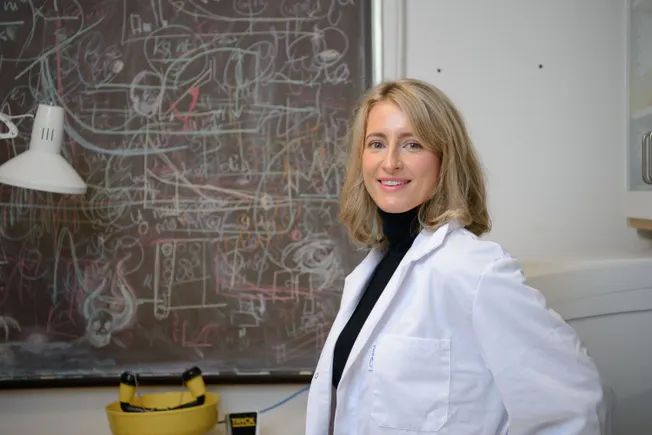
Memory sometimes lingers on small moments. For Sana Alajmovic, these moments include: waving goodbye to her father and grandfather as the bus drove away from their Bosnian village; asking the driver to stop because her brother had forgotten his fish-printed pillow; and sleeping on benches under the Croatian stars because the family had nowhere to go.
When asked if she remembers the family's escape from the former Yugoslavia months before the Bosnian War officially began in the early 1990s, she answers solemnly, "Yes, I do."
Alajmovic is the co-founder and CEO of Sigrid Therapeutics, a Swedish clinical-stage medical technology company. Its lead candidate, SiPore21, is being developed as a novel treatment aimed at improving blood sugar levels in people at risk for type 2 diabetes and obesity. SiPore21 is classified as a medical device and works by using orally administered mesoporous silica particles as a "molecular sieve" to block the activity of food enzymes.

But getting here has been a long and challenging journey. During the war, her politically active physician father and judge mother were "quite high on the (kill) list." As refugees, they had to start from scratch.
"You come here with nothing. You have to rebuild everything, and your mother, who was a judge, is now cleaning toilets," she says. "You can see her frustration. She instills in you that you have nothing in this country, I can't give you anything, you have to study, you have to earn your own bread in this country."
When Alajmovic's father finally joined them in Sweden a few years later, he had to retrain as a doctor from scratch—and in a foreign language—because Bosnia was not an EU member at the time.
The war experience planted seeds of resilience in Alajmovic, while what happened at home ignited a lifelong interest in healthcare.
From the age of 12, Alajmovic helped carry the family burden—delivering newspapers, working in a sandwich factory or a nursing home—while her father's health deteriorated. His blood sugar levels climbed, eventually leading to prediabetes.
"The doctor told him, 'We have no medication for you now. Come back when you develop type 2 diabetes, because then we have plenty of drugs for you,'" Alajmovic recalls. "That was my first encounter with the flaws of a healthcare system that focuses more on managing disease than preventing it."
The sum of experiences
Watching her father struggle with a chronic condition, and everything that came with it—mood swings, sores on his feet, fatigue—stayed with her.
"As an entrepreneur, that influences how you build a company," she says. "It influenced some of the decisions I made in positioning and building Sigrid."
When Alajmovic teamed up with Tore Bengtsson, a professor and researcher in physiology and biology at Stockholm University, to co-found Sigrid, she realized the potential for a product that could prevent the kind of lifestyle disease that afflicted her father—even if others were skeptical.
"I'm proud of our 'bold vision' to prevent disease," she says. "Many people told me you can't make money preventing disease, no one cares about prevention. But I think that's changing, and I think the COVID-19 pandemic accelerated that shift."
The mesoporous silica particles in SiPore21 are a finely ground powder that can be administered in an edible gel or capsule form. The particles themselves are not absorbed into the bloodstream but are harmlessly excreted in feces. SiPore21 is patented in the US, EU, Canada, Australia, Japan, and Israel, among others.
"You have a PhD in organic chemistry and physiology. But I have a PhD in execution."

Sana Alajmovic
Co-founder and CEO of Sigrid Therapeutics
According to Alajmovic, the company targets people at risk for chronic lifestyle diseases, such as those with prediabetes, obesity, and early-stage type 2 diabetes, when the condition is still reversible.
"We are the first and only company in the world to combine this cutting-edge materials chemistry with unique insights into human physiology," she says.
She adds that the company expects to launch a double-blind, placebo-controlled, randomized, multicenter study of SiPore21 in the spring, involving about 300 patients.
90% execution—10% idea
Alajmovic studied economics at the Stockholm School of Economics, much to her parents' dismay, who would have preferred their daughter to become a doctor or lawyer. Those careers didn't appeal to her, but the typical career path for economists—banker or consultant—didn't interest her either.
"I wasn't interested in any of that. I couldn't see how they contribute to human well-being," she says. "No offense to bankers or consultants, but I found it hard to be passionate about that kind of work."
After working in venture capital and investment, co-founding Sigrid also taught Alajmovic another profound lesson.
"Even if you didn't come up with the idea, you can still be an entrepreneur," she says. "Entrepreneurship is 90% execution and 10% idea. So, if you don't have the idea, don't be paralyzed by that. Go find that creative person."
"We are the first and only company in the world to combine this cutting-edge materials chemistry with unique insights into human physiology."
Sana Alajmovic
Co-founder and CEO of Sigrid Therapeutics
Alajmovic says she is the only one on the 12-person team without a PhD, but that doesn't diminish her capabilities.
"You have a PhD in organic chemistry and physiology. But I have a PhD in execution," she tells her team. "There's so much involved in taking a lab discovery and turning it into a product."
Alajmovic sees her strength in seeing the big picture and driving the complex pieces—from raising capital to scaling lab work into commercial, industrial production, and everything in between.
"It's a capital-intensive industry. The time to market is very long. It's not like tech, where you can build an app in a few weeks," she says. "We're talking about years."
Her ability allows her to see the bigger picture and understand what they need to do to make the vision a reality. And, given the long timelines, it's crucial not only to stay excited about the big wins, which are often few and far between, but also to find passion in the day-to-day, brick-by-brick building of the company.
"I feel energized. I feel like I'm truly living. I feel like I'm living with purpose," she says.
While some entrepreneurs think about exit strategies, Alajmovic doesn't. She thinks about the mission of preventing diseases like her father's.
"I wake up every morning and never think about those things," she says. "What really matters is the journey itself."