
Gilead's New HIV Prevention Drug Yeztugo: Hope and Challenges in Ending AIDS
Gilead Sciences' HIV prevention drug Yeztugo (lenacapavir) has received FDA approval, demonstrating 100% efficacy in clinical trials. Despite obstacles such as funding cuts and cultural stigma, the company is advancing large-scale distribution through a global partner network, aiming to reach 2 million people over the next three years.
Vaccines are often the best tool to curb the spread of a virus. However, the long quest to stop HIV has proven to be far more complex.
In the absence of a viable vaccine, drug developers over the past few decades have created a range of antiretroviral drugs and pre-exposure prophylaxis (PrEP) medications. These options have shifted the trajectory of the disease from a high probability of death to a manageable chronic condition. Yet, a curative therapy or vaccine remains elusive.
However, one of the most powerful weapons against HIV to date is now emerging.
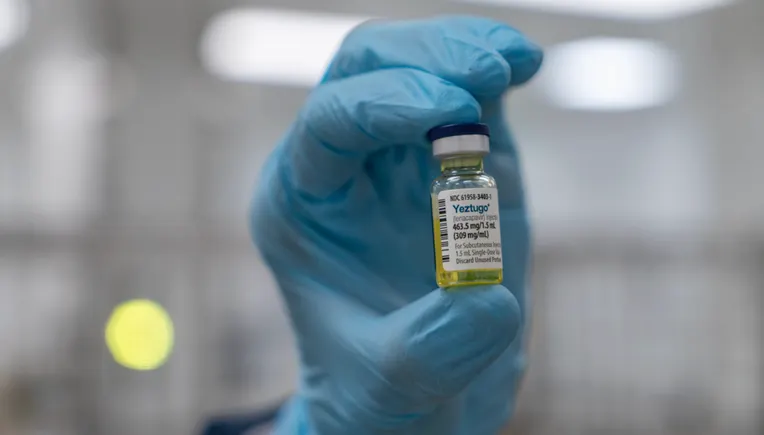
Gilead Sciences received FDA approval for a PrEP drug last year that the company's Chief Commercial and Corporate Affairs Officer, Johanna Mercier, says has the potential to "end HIV."
This launch follows Gilead's landmark results in clinical trials. The Phase 3 trial tested its long-acting PrEP drug lenacapavir in thousands of participants to prevent new infections and demonstrated 100% efficacy in cisgender women.
"It gave all of us goosebumps," Mercier said, describing the moment they learned of the trial results. "But right after that: let's get moving."
While other PrEP drugs have been approved as daily oral pills or bimonthly injections, the new formulation only requires administration twice a year—significantly reducing the major accessibility burden faced by patients.
The drug is now marketed under the brand Yeztugo and, according to Mercier, has been approved in 50 other countries. Although Yeztugo marks a milestone achievement in drug development, the work to get it into patients' hands is just beginning.
Gilead now faces the challenge of delivering the needed doses within a global treatment landscape hit by funding cuts and still mired in cultural stigma. To achieve this, Gilead is relying on a vast network of international partners, its historical expertise in HIV, and lessons learned from past pharmaceutical industry missteps in this area.
Rapid launch
Within weeks of Yeztugo's clinical success, Gilead began laying the groundwork for a massive global rollout, announcing royalty-free voluntary licensing agreements with six generic drug manufacturers to supply the drug in 120 low- and middle-income countries.
"We started working early, even before submitting to the FDA, to ensure we could enter regions like sub-Saharan African countries in the same year," Mercier said.
According to UNAIDS estimates, approximately 1.3 million people worldwide were newly infected with HIV in 2024.
Gilead's production agreements are part of its broader goal to provide doses for up to 2 million people at zero profit over the next three years. This far-reaching effort brings together multiple partners, including The Global Fund, the Gates Foundation, the Clinton Health Access Initiative, and others.
While Gilead is "critical" in creating access to Yeztugo, the complexity of its rollout will require a wide range of stakeholders, including local governments and regulators, to do their part, said Mitchell Warren, executive director of AVAC, a nonprofit that operates like "air traffic control," helping donors and implementers deliver HIV prevention options.
Past global rollouts of this scale have not always gone smoothly.
"Over the past 15 years, we have seen the field squander every PrEP opportunity," Warren said.
HIV impact
- 1.3 million: New global HIV infections in 2024.
- 3.5 million: New PrEP users globally in 2023—far below the UN target of over 21 million people on PrEP.
- 44.1 million: Total recorded HIV-related deaths globally in history.
Warren explained that after the approval of ViiV Healthcare's Apretude (long-acting injectable cabotegravir) in 2021, rollout was hampered by years of negotiations over pricing and production. Yeztugo is different; Gilead is locking in production plans at a much faster pace while addressing cost issues.
"In the 18 months since we knew Yeztugo was safe and effective, we have seen every milestone achieved much faster than any other drug," Warren said.
Meanwhile, in the U.S., Gilead has secured coverage for Yeztugo from about 85% of payers and achieved "zero copay" for 90% of plans, Mercier said. The company has also launched a program for uninsured Americans to receive Yeztugo for free; the drug's list price exceeds $28,000 per year.
While some analysts expect Yeztugo to eventually reach blockbuster status, Gilead's sales target this year is $800 million.
Many obstacles still need to be overcome to keep Yeztugo doses flowing to new patients.
After Trump took office
International aid has long been central to the global HIV response—according to the UN, it funds 80% of prevention programs in low- and middle-income countries. But the sudden and drastic funding cuts triggered by the Trump administration last year led to a 30% to 40% drop in international aid for HIV programs in 2025.
This funding retreat could threaten Yeztugo's global accessibility, which depends on a carefully built network of patient services.
"A period of uncertainty or cuts in external funding can quickly impact prevention programs because PrEP access depends not only on the drug but also on the clinics, community outreach, testing services, and health workers that support delivery," said Ravini Senanayake, public relations manager at The Global Fund, in an email.
Although the "financing environment is challenging" now, organizations like The Global Fund are working with governments and partners to "help protect the continuity of prevention and treatment services," Senanayake said.
"There is a cruel irony now. One of our biggest opportunities is emerging during one of the most politically difficult periods."
—Mitchell Warren, Executive Director of AVAC
Some of the cut revenue streams have since been partially restored, such as the U.S. PEPFAR program, which, according to the program, "accounts for over 90% of global PrEP initiations." But whether the actions organizations have taken to fill the HIV treatment gap will be enough for Gilead to meet its access goals remains to be seen.
"There is a cruel irony now," Warren said. "One of our biggest opportunities is emerging during one of the most politically difficult periods... So we are starting with our hands tied behind our backs."
Warren said it is particularly uncertain whether health ministries in various countries have the budgets to purchase Yeztugo doses for their citizens.
"Right now, they are struggling to pay for treatments that keep people alive, so they will not prioritize prevention," he said. "So there is a huge question mark over whether we will see great science translate into public health impact."
South Africa is particularly vulnerable to political and financial obstacles.
Although South Africa has the largest number of people living with HIV in the world, the country has been a specific target of U.S. government funding cuts. According to the Associated Press, the temporary suspension of PEPFAR funding last year led to the closure of 12 specialized HIV clinics and thousands of job losses, after which a transition plan was implemented to restore aid. But that plan expires at the end of this month.
Gilead has been criticized for not including South African generic manufacturers in its production agreements and is currently negotiating voluntary licenses to produce generic Yeztugo in the country.
"Gilead supports working with the South African National AIDS Council, which will issue a request for proposals for generic manufacturing in South Africa," the company said in an email statement, adding that it will review proposals and "assess whether the required quality standards can be met" before granting any voluntary licenses.
Warren also noted that Gilead's licensing agreements still have "significant gaps" because they exclude countries in Latin America and Asia.
Even if supply targets are met, efforts to reduce HIV infections are closely tied to patient adherence.
In some programs that have already implemented monthly PrEP injections, only 70% to 75% of patients return on time for their required doses—a rate "far worse" than in clinical trials, Warren said. Although Yeztugo only needs to be taken twice a year, monitoring is crucial to ensure access programs help patients receive their doses on time.
"I don't want to find out in a few years that the clinical results were great, but we didn't see public health impact," Warren said. "Its success lies in the treatment programs."
Will Yeztugo end HIV?
Despite the various obstacles, Warren is optimistic that Gilead will achieve its goal of reaching 2 million patients. Although generic versions of Yeztugo will not be available until 2027, Gilead says it is providing the drug for free through PEPFAR and The Global Fund in the meantime.
But HIV continues to evolve and spread to new patient populations globally. Due to the complexity of reaching patients, completely eradicating HIV may require more than just a drug, Warren said.
"We still need to develop more options," Warren said. "Yeztugo cannot do this alone."
The story of HIV's eventual demise may still be written by a vaccine.
According to Gavi, an international vaccine nonprofit, a Phase 1 trial testing a novel mRNA vaccine candidate is planned to start this year. The study will contribute to a growing body of research testing whether mRNA can overcome the historical scientific obstacles to developing an HIV vaccine.
ViiV also remains active in HIV drug development, with four treatment and prevention drugs in its clinical pipeline. Meanwhile, Gilead has several drug combinations in clinical trials, with the ultimate goal of providing a cure.
In the ongoing effort to "innovate beyond ourselves," Mercier hopes that with PrEP or other treatments, Gilead will play a leading role in stopping the virus.
"I hope to see that day in my lifetime," she said. "That would be a huge achievement. But I am also realistic that we are on a journey."
