
This 'passionate' CEO is dedicated to revolutionizing the way burn patients heal
Daniela Marino, CEO of Swiss biotech company Cutiss, is driving the clinical development of denovoSkin, a personalized bioengineered skin graft, with her signature passion and determination, aiming to change the standard of burn treatment.
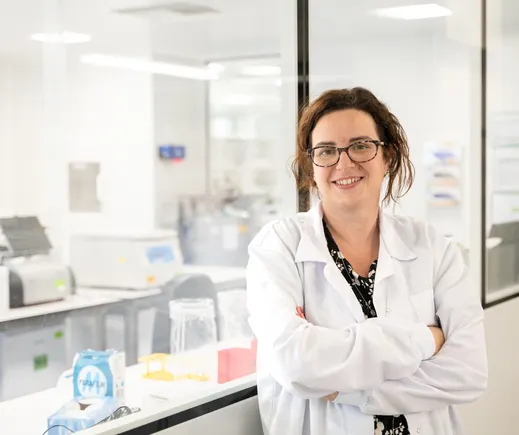
On a working day in early April, if you were on the same tram as Daniela Marino, you might have heard her excited screams. That day, she screamed in the office too, and continued after returning home.
Marino's excitement was not without reason. Her Swiss biotech company, Cutiss, had not onlyjust announcedpositive results from the Phase 2 clinical trial of its lead product, denovoSkin, but Nasdaq had also displayed a huge congratulatory message on its iconic screen in Times Square.
"When Nasdaq reported the Phase 2 results, you can imagine... I was very loud," she said with a laugh.
Marino's passion for her company, science, and life is infectious. Her speech and social media posts are filled with exclamation points, both figurative and literal. As a "loud" Sicilian working in the Swiss biotech world, she has no intention of suppressing her exuberant personality.
"We are naturally passionate people. We scream, talk loudly, laugh, and joke around; that's who I am," she said. "I am very emotional and passionate about my work, and I don't feel the need to hide it."
A new standard of care
Marino is the CEO and co-founder of Cutiss, a Swiss clinical-stage life sciences company focused on regenerative medicine, tissue engineering, and skin pigmentation. Its lead product, denovoSkin, is a personalized bioengineered human skin graft that, in Phase 2 trials, showed efficacy as a dermal-epidermal skin substitute in adult and adolescent burn patients.
Unlike traditional skin grafts, which transplant a thin layer of skin from a donor site (a technique Marino calls a "technique" rather than a "product"), denovoSkin generates multi-layered or full-thickness skin tissue. Moreover, it can bioengineer large amounts of skin from a stamp-sized sample of healthy skin.
"I can take a stamp and give you back a 'carpet of skin,'" Marino said.
The company says denovoSkin also has the potential to surpass the current standard of care because it can grow with the patient, reduce scarring, and significantly reduce the number of follow-up corrective surgeries, especially in children. Marino added that the product develops into near-normal skin, improving patients' quality of life in terms of function, elasticity, smoothness, pain, itching, contracture, and aesthetics.

"It will look better and feel better, which is why we believe this product has a unique opportunity to address a huge problem," she said.
Beyond burns, the technology could also be used for skin trauma, reconstructive or cosmetic surgery, skin cancer, and congenital skin deformities.
Cutiss plans to target the European and Swiss markets, and eventually the United States. denovoSkin has been granted orphan drug designation for burn treatment by Swissmedic, the European Medicines Agency (EMA), and the U.S. Food and Drug Administration (FDA). In early 2022, the company also acquired the global exclusive commercialization rights to VitiCell, a skin repigmentation product developed and patented by IBSA Pharma.
From lab to executive suite
Cutiss was founded in 2017 as a spin-off from the University Children's Hospital in Zurich. After studying biotechnology and biology in Milan, Marino moved to Switzerland for her PhD and managed a translational medicine skin graft project at the University of Zurich, which eventually evolved into Cutiss.
"When I saw the results of the Phase 1 trial—conducted on 10 children in Zurich—I thought this was too good to remain only in academia and publications," Marino said.
"I saw something that could greatly change patients' lives, and I thought, someone has to push it forward."
In North America and Europe, there are about 60,000 severe burn patients and over 1.5 million reconstructive surgery patients each year. Given the promising science and unmet need, Marino began looking for someone who could turn the academic work into a company. When no one stepped up, she decided to do it herself.
"I took on the challenge myself," she said.
Although she had originally planned to "stay in the lab" for life, in co-founding Cutiss, Marino discovered that "what drives me as a scientist also drives me."
"I saw something that could greatly change patients' lives, and I thought, someone has to push it forward, and if there's no one better than me, maybe I should seize the opportunity," she said.
A bold approach
Despite leaving academia, Marino says she has never had time to be bored. There is always something to do, learn, or a problem to solve.
"Starting a company from scratch is like riding a roller coaster every day," she said.
The company expects the full data analysis from its Phase 2 trial, including three-year follow-up, to be published in 2025. Additionally, the company just sent a piece of skin to the International Space Station as part of an advanced R&D mission. By observing biological processes and cellular behavior of skin tissue in the space environment, Cutiss hopes to develop wound healing strategies for astronauts during spaceflight, deepen understanding of the space environment's impact on human health, and advance new medical technologies and treatments for people on Earth.
Meanwhile, Marino has also learned how to create and lead a company without losing herself. Just two months after Cutiss was founded, Marino gave birth to her second child. But the experience of new motherhood did not slow her down—instead, she integrated it into her company management, bringing her mother and newborn to early investor meetings.
At first, she said investors were shocked by the presence of the baby, but eventually accepted it. One potential investor even offered to hold the baby, eventually lulling the fussy little boy to sleep in his arms. Marino joked about hiring him as an assistant, and although she was joking, that investor ultimately invested in Cutiss.
"It felt great because you can change things in extremely bold ways, just by saying, 'Look, this is what I want to do,'" she said. "My career is my career, and my family is my family, but I don't want to give up either. So you'll have to listen to my silly jokes about motherhood, and you'll get used to it. Somehow, it worked."
This is just one of the ways Marino unapologetically is herself, and her communication style conveys her commitment to the company and her work.
"Part of me is now in my company, so I don't want to hide it," she said. "Part of the reason we've been able to continuously raise funds is that people can feel the passion in the story."
If they occasionally hear her scream with excitement, so be it.
"That's just me," Marino said.