
99 Seconds That Changed a CEO's Life: From Leukemia Ward to New York Marathon
Sermo CEO Peter Kirk, after being diagnosed with acute myeloid leukemia and receiving a bone marrow transplant, went from running only 99 seconds initially to completing the New York Marathon, and founded the 'Run with Peter' global doctor running fundraiser. His story demonstrates the power of setting goals, making public commitments, and community support.
One minute and thirty-nine seconds — that's how long it took Sermo CEO Peter Kirk to run 200 meters to the first traffic light on his block, just five weeks after being discharged from the hospital following a year-long stay. Despite feeling disappointed with this first attempt at returning to normalcy, Kirk's journey from a life-changing diagnosis to recovery, and how he 'found his possible,' is nothing short of remarkable.
About a year ago, on October 22, 2020, Kirk's wife urged him to see a doctor because he had been feeling unwell for several days, but he thought it was just an upset stomach.
"I'm the typical stubborn tough guy who thinks he doesn't need to see a doctor, that I'm fine," he said.
"I have neutropenia, which keeps me in regular contact with a hematologist, but mostly for antibiotics for colds or minor ailments. But my wife said, 'You have to go see (the hematologist).' He ran routine blood work, and when he saw my white blood cell count was far above normal, he said: 'You need to go to the hospital right now, this is very serious.'"
Kirk's diagnosis shocked his family: acute myeloid leukemia, an aggressive blood cancer. About 48 hours later, he was placed in an induced coma and intubated. (Kirk's full medical journey is documented in a short three-part documentary.)
"It all came without warning, because just weeks earlier I had blood work done and everything was normal," he said.
Over the next year, Kirk received nearly twenty blood transfusions, multiple rounds of chemotherapy, and on June 9, 2021, underwent an '850 million cell bone marrow transplant.' The treatment was successful, thanks to a transfusion from donor Sam, obtained through Be the Match — whom he later met — and Kirk was declared cancer-free.
"The doctors told me the procedure was very successful. But after a stem cell transplant, you're incredibly weak, almost a shadow of yourself. I needed help climbing a few stairs and couldn't even open a soda can," Kirk said. "I recuperated with my family at a friend's house by the beach. I could swim a few laps in the pool — making progress little by little. Back in New York, one day, just six or seven months post-transplant, I decided to go for a run."
The Critical Next Step
Determined to step out of the 'shadows' and no longer just be a patient, Kirk laced up his running shoes. He knew he wouldn't set any records; he made a promise to himself that he would run as fast as he could, and if he had to stop, he would stop.
"I ran to the first traffic light and had to stop. My first run lasted only 1 minute and 39 seconds... barely one block," he recalled. "Walking home, I didn't run as promised, but I was panicking inside, thinking: Is this the new me? I remember very clearly wondering if I should start doing 'old man exercises'? Though I wasn't sure what that meant, maybe some slow machine exercises. Then my next thought was: absolutely not. I need a big goal. I need to do something truly significant."
"The hardest part now is getting people to understand that it's not just about running; it's about you doing something; that's your possible."
— Peter Kirk, CEO of Sermo
Within the next 10 seconds, Kirk decided to sign up for the 50th New York City Marathon. Having never run a marathon before and not even considering himself a 'runner,' he began researching the registration process.
"That evening, I took my family out to dinner and said: 'I'm going to run the New York Marathon.' They thought I was completely crazy," he recalled.
Goal and deadline set: he had 12 weeks to prepare to run 42,200 meters.
The next day, he announced his goal to Sermo's leadership team, and they too questioned his sanity. But undeterred, he used a technique that had helped him overcome challenges in the past: telling as many people as possible. So he posted the news on LinkedIn.
"I find it helpful to let a lot of people know what you're doing, because then you really can't back out," he said. "What I didn't expect was the response; it was overwhelming."
Ironically, as CEO of Sermo — a social network platform that brings together over one million doctors globally — he personally doesn't use social media.
Messages from the online community ranged from 'how inspiring' to 'amazing' to 'we'll be with you every step of the way.'
"It was crazy. Now, I really couldn't stop," he said.
He started running, initially aiming for 200 meters. After struggling to go further, Kirk admitted he was 'close to giving up.' But the next day he put his running shoes back on, promising to complete a full loop around the block 'no matter what.'
"I remember thinking: I'm going to run very slowly, just staring at the ground, and not stop," he said. "I didn't look up to see how far the next point was. My legs were moving slowly, but I wasn't walking; I completed the loop — half a mile. That fifth run was the hardest and most important. After that, I started to improve."
 Sermo CEO Peter Kirk (right) met his 23-year-old stem cell donor Sam at the Be The Match gala last November.
The Next Chapter
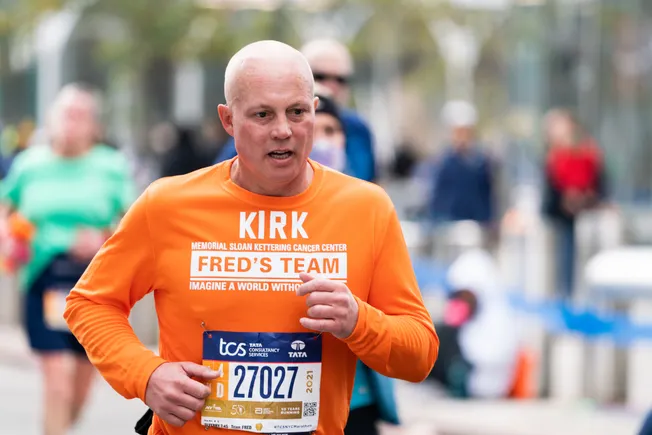
On November 7, 2021, wearing bib number 27027, Kirk was determined to cross the finish line and 'start' the journey of the rest of his life.
Amid cheers from family and friends along the 26.2-mile course, five hours and forty minutes later, Kirk achieved his goal and tore off the patient wristband from his last hospital visit. This officially ended his identity as 'defined by cancer.'
"After the New York Marathon, with the amazing feedback and people saying they were inspired by me, I felt a bit empty," Kirk said. "I thought, you just got everything you wanted: you got the transplant, you survived, you have a wonderful family. You're no longer defined as a patient, so why do I feel empty? What's next? What should I do?"
Less than a week later, Kirk surprised even himself. He decided to go for a run, despite having promised not to run for at least six weeks.
"It wasn't planned, not deliberate," he said. "I put on my shoes and thought: Where should I go? I decided to head to the Hudson River. Then I thought, if I run to the Brooklyn Bridge, that's less than a mile away, and if I run back, that's a half marathon. So, maybe I could try it."
The following week he ran two more half marathons. During his third run in 10 days, a lightbulb went off: 'This could be my mission.' Running had become joyful for him, and he thought it could be a way to inspire others. He set another 'big goal': to run 1,000 half marathons by the tenth anniversary of his transplant.
"That's a meaningful story," he thought. He shared his vision with Sermo's leadership team, and they came up with the idea of 'Be your possible.'
"The half marathon became a way for me to hopefully inspire you," he said. "The hardest part now is getting people to understand that it's not just about running; it's about you doing something; that's your possible."
Kirk now typically runs two to three half marathons a week and is eager to do more. With his team's help, he decided to leverage Sermo's network of doctors.
"Sermo has many doctors who want to raise funds for medical research, and I thought of having the company help organize the first global doctors' running event," he said. "Doctors lace up their shoes, tell us how far they want to run, and then tell us which medical research organization they want their miles and donations to support."
This was the beginning of the 'Run with Peter' 'Lace Up to Save Lives' initiative. The inaugural event in June 2022 saw 2,400 doctors from 77 countries participate. "I think they ran about 24,000 miles in total, and we raised $250,000," Kirk said.
Donations went to various organizations, including the American Heart Association, St. Jude Children's Research Hospital, the International Society for Infectious Diseases, and the Breast Cancer Research Foundation.
His advice to those facing great challenges: set a goal, whether big or incremental, and the important thing is to keep moving forward. And, of course, tell as many people as possible to maintain motivation and accountability.
"You'll be surprised by the support you get," Kirk said. "Set goals. Don't accept the status quo, because if you do, chances are you'll never move forward, or not in a meaningful way."