
Moderna Executive: Global Health Is the Only Way Forward
Determined to enter the pharmaceutical industry at age 15, Chantal Friebertshäuser joined Moderna late last year after stints at Eli Lilly and Merck, overseeing commercial operations in Europe, the Middle East, Canada, and Australia. She firmly believes that viruses know no borders and that global health collaboration is the only way forward.
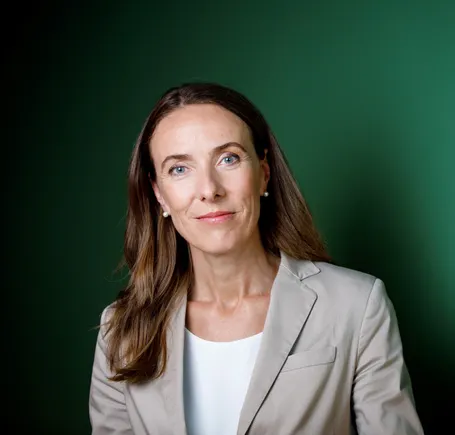
At the age of 15, Chantal Friebertshäuser made a decision that was unusual even for the most precocious teenager: she set her sights on a global career in the research-driven pharmaceutical industry.
At the time, she had just read a magazine profile of Lindsay Owen-Jones, then CEO of L'Oréal. At that time, L'Oréal was not only a cosmetics giant but also involved in pharmaceuticals through its acquisition of a company that later became Sanofi-Aventis. Friebertshäuser was torn between her interests and ambitions: she wanted to improve people's lives, loved languages and exploring the world, and had developed a strong passion for business from watching her parents run a small company and encouraging their children to think strategically about management.
She had considered becoming a doctor or a foreign language teacher, but after reading Owen-Jones's story, she realized she didn't have to choose—she could have it all.
"I realized, 'Oh my God, I don't have to choose,'" she says. "If I go into the commercial side of the research-driven pharmaceutical industry and take on a global role, then everything I want and love comes together."
Throughout her career, Friebertshäuser has done exactly that. She has built a global career in the pharmaceutical industry, most recently at MSD, where she served as Senior Vice President of Human Health and Managing Director of MSD Germany. Before her 15 years at MSD, she spent a decade in marketing and sales at Eli Lilly.
"If you don't think about health from a global perspective, you cannot have the impact you can and should have."

Chantal Friebertshäuser
Senior Vice President, Commercial, Europe, Middle East, and Canada at Moderna
Late last year, she moved to Moderna as Senior Vice President of Commercial Operations for Europe, the Middle East, Canada, and Australia. The role reflects Moderna's strategic focus on expanding its global reach. Before the pandemic, the company was relatively unknown—now it is one of the most watched biotechnology companies in the world.
Friebertshäuser says the company is now focused on "putting local people on the ground" as it works to build access globally.
"Moderna was only a research company until two years ago, and now with the first vaccine commercialized during the pandemic, and... a huge pipeline coming, building this organization globally is more important than ever," she says.
Beyond its COVID-19 vaccine, Moderna now has 48 mRNA programs, 38 of which are in active clinical trials, with operations in 17 countries worldwide. These include its experimental mRNA vaccine candidate against respiratory syncytial virus, which received Breakthrough Therapy designation from the U.S. Food and Drug Administration in January.
With production facilities coming online around the world and potential new drug approvals on the horizon, Friebertshäuser is part of Moderna's push to expand its reach.
Targeting a virus without borders
Since joining Moderna in December, Friebertshäuser has been on what she calls a "learning and development journey": visiting regions, meeting key stakeholders and customers, and "hearing directly from them about their challenges, needs, and how they think about working with a company like Moderna in the future."

On both a personal and professional level, taking a global approach to health and medicine is significant for Friebertshäuser. She is French, and her parents were born before World War II, when France and Germany were enemies. After the war and during the Cold War, geopolitical relations shifted. In her early twenties, Friebertshäuser moved to Germany and learned German for her early work at Lilly. Today, she is married to a German man, and their children hold both French and German citizenship.
Her experience is a microcosm of modern Franco-German friendship and shows that with the right leadership, effort, and will, "the worst enemies (can) become the best of friends and... the core of the European Union, the core of peace in this part of the European continent," Friebertshäuser says.
"I think it's a lesson for life," she says. "For me, in a way, it's also a big lesson in leadership."
During her time at MSD, she was responsible for the HPV vaccine business and worked with governments and organizations such as the World Health Organization and UNICEF to ensure global access to this world-changing, cancer-preventing vaccine.
"For me, it wasn't a job; it was like a mission," she says.
At Moderna, she feels the same sense of mission because of the company's mRNA platform.
"Moderna's promise is to change the world by providing a very different range of vaccines and therapies, and to do it in a way that access is by definition broader, more personalized, and different," she says.
She believes that working with stakeholders from different countries and cultures is about agreeing on and working toward common goals, and that the global commitment to shared health goals is "deeply embedded in Moderna's DNA." For example, she points to the company's commitment to advance 15 vaccine programs targeting emerging or neglected infectious diseases, including HIV, tuberculosis, and malaria, into clinical studies by 2025, as part of itsglobal public health strategy.
"This is exactly how we want to engage with every country or type of customer: What are the common goals for the future, and how can we best engage together?" Friebertshäuser says.
The governments in the regions she now covers understand that health cannot be approached in isolation. Moderna is also working to develop global partnerships to this end. Friebertshäuser says this commitment makes sense, especially after a pandemic that showed the world in a stark way that "there is no alternative to global health."
"You can close borders, you can build walls or tear them down—it doesn't matter. Viruses have no borders, bacteria have no borders," she says. "If you don't think about health from a global perspective, you cannot have the impact you can and should have. That's it."